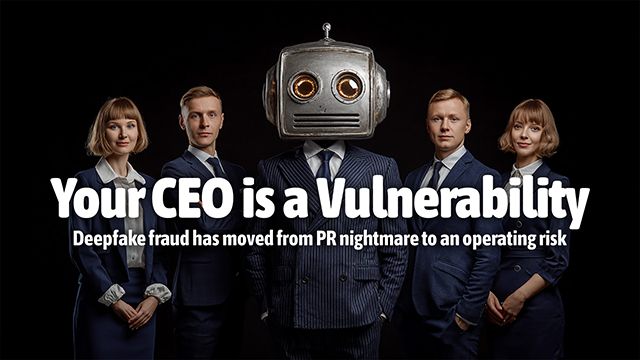


Your CEO is a Vulnerability - Deepfake fraud has moved from PR nightmare to an operating risk
Sources
It arrived in badly written emails, improbable invoices, weird domain names, or frantic requests from a “CEO” who suddenly sounded like he had been kidnapped by punctuation errors. It was clumsy, recognizable, and often easy to laugh at after the fact. That era is ending. The new fraud does not ask to be believed because it is clever. It asks to be believed because it looks and sounds familiar enough to slip past the one control most organizations never formally modeled: instinctive trust.
That is what deepfake fraud changes. It does not merely create false images, cloned voices, or fabricated videos. It weaponizes the habits that make organizations function in the first place. People move quickly because senior leaders ask them to. Teams respond because the face on the screen is one they know. Finance staff release funds because the voice on the call sounds exactly like the person who has authority to demand urgency. In that environment, the issue is not whether a fake is perfect. It is whether it is convincing long enough to trigger action.
And that is why this matters far beyond cybersecurity.
Too many executives still talk about deepfakes as though they belong in the same bucket as viral misinformation, celebrity scams, or the occasional embarrassing social-media hoax. That framing is dangerously outdated. Synthetic media has matured into a business operations problem. It touches treasury, legal, communications, investor relations, HR, procurement, compliance, and the board. It is now a control failure that can travel through any channel where identity once acted as proof.
The real asset under attack
When companies talk about protecting assets, they usually mean cash, systems, intellectual property, customer data, or maybe the occasional overpraised “brand equity” deck.
But the asset deepfake fraud targets first is executive authenticity.
That sounds abstract until you think about how much of modern enterprise depends on it. The CEO’s voice can trigger capital movement. The CFO’s approval can release funds. A division president can accelerate a vendor decision. A board chair can calm a market, redirect a strategy, or freeze a crisis. Every one of those actions depends on a simple assumption: that people know who is speaking.
Deepfakes erode that assumption. Once that happens, the damage spreads in two directions at once. In one direction, criminals can impersonate leadership to move money, steal credentials, or manipulate decisions. In the other, real leaders lose the speed and authority that organizations expect from them because every communication becomes suspect. A company that cannot quickly trust what its own executives are saying is not just exposed to fraud. It is operationally slowed, strategically weakened, and more fragile in a crisis.
That is the real shift. Deepfakes are not just counterfeit media. They are attacks on institutional confidence.
Why boards are still behind
Most boards are still governing as if synthetic media were a technical nuisance that can be delegated downward.
That is partly because deepfakes arrived wearing the costume of a consumer-tech curiosity. For years, the conversation centered on fake celebrity clips, manipulated political videos, novelty voice clones, and internet junk. Corporate leadership saw the spectacle, not the trajectory. They treated it as reputational noise rather than as the next iteration of social engineering.
That complacency is now colliding with reality. Recent governance and policy discussions increasingly make the same point: the deepfake problem is not limited to one function, one jurisdiction, or one type of harm. It can drive direct financial loss, distort market perception, trigger regulatory scrutiny, and damage trust even after the content is disproven. By the time a company has finished debating whether a clip is authentic, the public may already have decided that the correction is less interesting than the lie.
Boards are uncomfortable with this because it exposes a familiar weakness. Many directors are willing to review AI strategy, approve AI spending, and nod solemnly at AI ethics presentations. Far fewer are prepared to ask whether the organization has a rehearsed protocol for a fake CEO statement, a synthetic earnings leak, a cloned voice requesting a transfer, or a fabricated executive confession that races across social media before legal even joins the call.
That gap is not technical. It is managerial. It comes from treating trust as culture instead of control.
This is not just cyber. It is operations
The most important mistake leaders make is handing deepfake risk to one silo.
If the issue sits only with cybersecurity, the company may invest in detection tools but ignore crisis communications. If it sits only with communications, the company may prepare talking points while treasury procedures remain laughably vulnerable. If it sits only with legal, the organization may polish disclosure language while front-line staff still have no escalation path for suspicious executive requests. If it sits only with compliance, everyone will feel reassured right up until the wire transfer clears.
Synthetic media risk is inherently cross-functional because it attacks business process through trust channels. It reaches people through calls, messages, meetings, approvals, onboarding, vendor changes, media appearances, and emergency instructions. That means the correct response is not one new software subscription and a short webinar with a stock photo of a hacker wearing a hoodie. The response has to be operational design.
Companies need to decide, in practical terms, what no one person can authorize alone, what kinds of requests always require out-of-band verification, which executive communications are considered high-risk, who owns validation during a suspected impersonation event, and how the organization communicates publicly when a fake begins to move faster than the truth.
The question is not whether your employees know what a deepfake is. The question is whether your business process still assumes they can trust what feels familiar.
The old model of authority is breaking
For decades, corporate process quietly relied on a shortcut: if it sounds like the boss, came from the boss, or appears to involve the boss, act quickly. That shortcut made sense in a lower-noise environment. It is now a liability.
Deepfake-enabled fraud works so well because it exploits hierarchy, urgency, and obedience at the exact moment people are taught not to be obstacles. The employee who stops a suspicious payment can look like a hero. The employee who delays a legitimate urgent request from the CEO can look like a problem. In many organizations, the cultural reward structure still favors fast compliance over skeptical verification. That is precisely the opening attackers need.
This is why the deepfake threat is not just a technology story. It is a management psychology story. Bad actors are not defeating encryption with cinematic genius. They are exploiting the human cost of questioning authority inside institutions that celebrate decisiveness until it becomes expensive.
In other words, the fraud gets smarter because the culture stayed lazy.
The communications team has entered the blast radius
There is another reason deepfakes deserve board-level attention: the moment a convincing fake enters public circulation, the communications function stops being a support team and becomes part of the control environment.
That is a profound change. Traditionally, communications would respond after an operational incident. In the synthetic-media era, communications may be among the first lines of defense because a fake executive statement, fake apology, fake interview, or fake instruction can trigger customer confusion, employee panic, reputational damage, and investor speculation before anyone confirms what happened.
That means crisis comms can no longer be built around the leisurely fantasy that the company will verify facts, align stakeholders, clear language, and respond in the next news cycle. The timeline is now measured in minutes, not committee moods. If the organization does not have pre-authorized response mechanisms, known internal escalation paths, and a plan for rapid public authentication, it is not merely underprepared. It is volunteering to let the fake set the first narrative.
And in crisis communications, first narrative still matters more than later precision.
Detection matters, but procedure matters more
The market loves a technical solution because software is easier to buy than discipline.
Yes, detection tools matter. Monitoring synthetic media, flagging manipulated content, and using forensic analysis will become part of the enterprise toolkit. Governments and institutions are clearly moving in that direction, and the pressure to establish standards is only growing. But the uncomfortable truth is that detection alone is not enough because deepfake fraud often succeeds before sophisticated review ever begins.
If a finance employee receives a convincing voice request to accelerate a transfer, the decisive control is not the detection engine that may someday analyze the audio. The decisive control is whether the payment process required a second human, a separate authentication path, and a known verification ritual that cannot be bypassed by status or urgency.
If a fake executive video starts circulating, the decisive control is not just whether your analysts can confirm manipulation within hours. It is whether your company can authenticate the truth faster than the fake can harden in public memory.
This is why mature organizations will treat deepfake defense as a layered problem. Technical detection helps. But process design, role clarity, pre-commitment, and rehearsal are what keep the damage from becoming irreversible.
The next control framework
The companies that get ahead of this will stop thinking in terms of “awareness” and start thinking in terms of friction. They will introduce deliberate friction into high-risk pathways. Not bureaucratic theater. Not performative sign-offs designed to make auditors smile. Real friction where synthetic media is most likely to exploit human trust.
That means treasury controls that cannot be overridden by a familiar voice. It means executive requests for sensitive actions that always require secondary validation through a separate channel. It means authenticated communication trees for crisis response. It means approved internal language for suspected impersonation events. It means social and media monitoring tied to named executive identities. It means rehearsals that include finance, legal, security, communications, and the people who actually have to make judgment calls under pressure.
Most of all, it means boards need to stop asking whether management is “aware” of deepfakes and start asking more uncomfortable questions. What would happen if a fake version of the CEO announced a strategic decision before market open. What would happen if a cloned CFO voice ordered a confidential transfer. What would happen if employees saw a fabricated executive confession and believed it for two hours. What would happen if the company proved the content was fake but still lost trust anyway.
Those are not hypothetical curiosities. They are governance questions.
Synthetic media changes the legal and audit story
There is also a legal consequence that many organizations still underestimate. Once deepfakes become a reasonably foreseeable business risk, the failure to design around them starts to look less like bad luck and more like negligent control design. That matters for audits, internal investigations, disclosure decisions, insurance disputes, and eventually litigation. A company that knew executive impersonation was plausible, knew financial institutions and regulators were warning about AI-enabled fraud, and still allowed sensitive actions to depend on easily spoofed identity signals is not going to look especially sympathetic after the loss.
This is where the conversation gets uncomfortable for leadership teams that have spent the last two years praising AI speed while ignoring AI-enabled attack surfaces. Deepfake fraud is one of those risks that turns hype into discoverable evidence. Every skipped control, every vague escalation path, every “we’ll handle that if it happens” assumption becomes easier to scrutinize after money leaves the building or the market reacts to a fabricated statement.
In other words, the problem is not merely that synthetic media can deceive. It is that it can reveal who was unserious about operational resilience.
What serious companies do next
Serious companies will treat executive identity as a protected enterprise asset, not as free raw material for attackers. They will assume that any public voice sample, video appearance, earnings call, keynote clip, podcast interview, or media segment can become training material for impersonation. They will govern accordingly.
They will redesign controls so no high-risk action depends on a single signal of authenticity. They will rehearse synthetic-media incidents before they happen. They will prepare public authentication pathways before their first fake goes live. They will make verification culturally acceptable even when the request appears to come from the top. They will force security, communications, legal, finance, and the board to work from the same playbook instead of pretending each one can protect the company separately.
And they will understand one more thing that still seems to surprise too many executives: in a world of convincing fakes, trust does not disappear. It becomes expensive, structured, and deliberate. That is the real transition underway.
For years, companies treated trust as the lubricant that made fast decisions possible. Now trust itself has to be engineered, tested, and defended like any other critical control. That may feel slower, less elegant, and faintly insulting to senior egos. But it is still cheaper than wiring money to a synthetic voice, watching a fabricated executive statement move the market, or discovering in front of regulators, litigators, and investors that your organization had no real plan for the day reality became optional.
Deepfake fraud is not a weird edge case anymore. It is what happens when the face of authority becomes just another file format.