



Sometimes a single sentence tells you everything you need to know about a certain kind of business culture.
I received an unsolicited email invitation from Vistage Worldwide, and it opened with a line that was apparently meant to sound insightful, exclusive, and psychologically sophisticated. Instead, it sounded like a distilled summary of everything that goes wrong when leadership becomes theater.
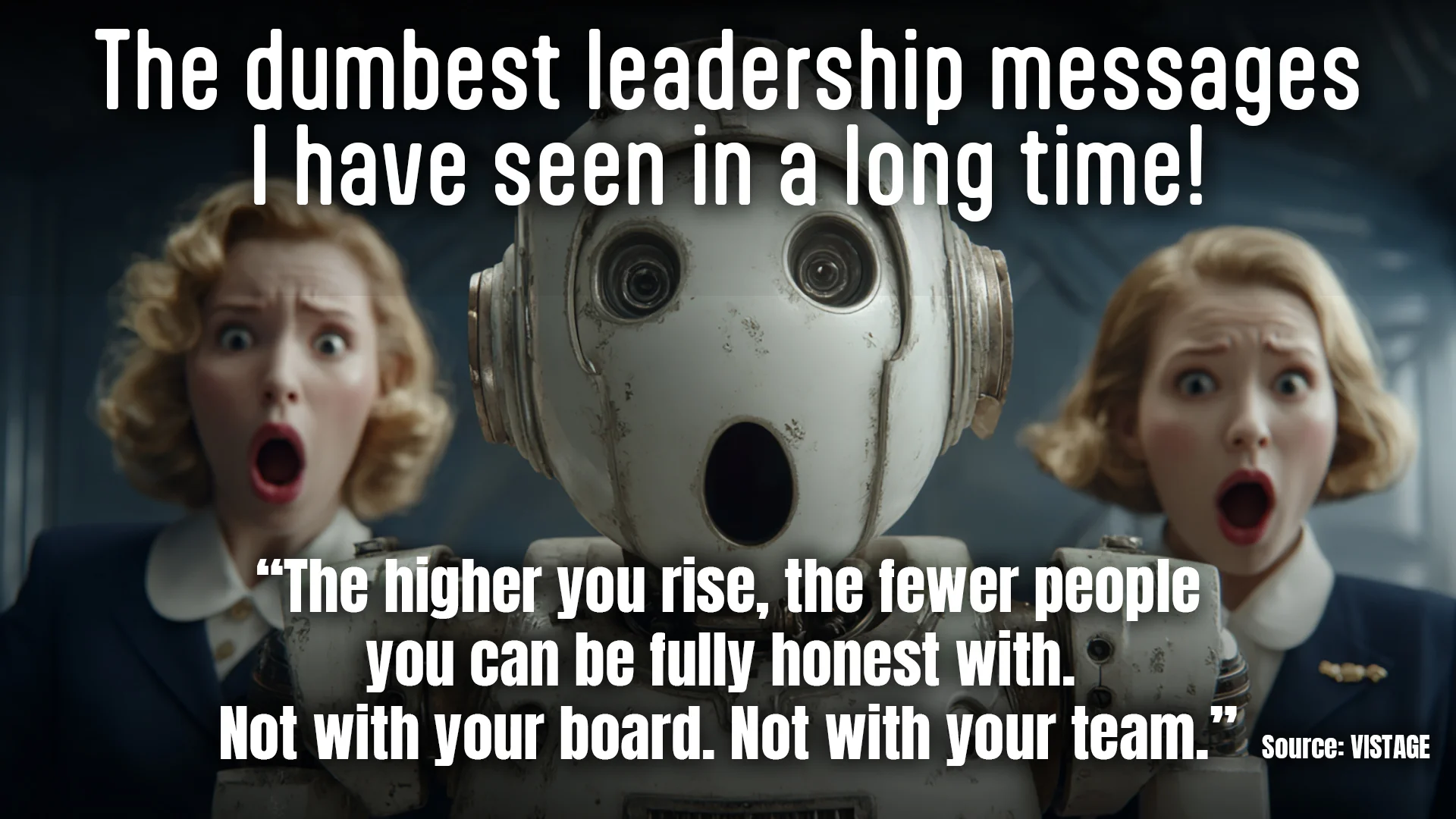
“The higher you rise, the fewer people you can be fully honest with. Not with your board. Not with your team. Definitely not with your competitors.”
Let’s leave competitors aside. No serious person expects full openness with competitors. That part is just filler. The real message sits in the middle of the line, where it matters: not with your board, not with your team.
That is where the sentence stops being clumsy marketing and starts becoming something worse. It turns distrust into a leadership principle. It romanticizes executive isolation. It suggests that honesty is not a foundation of leadership, but a resource that becomes less available the more power you gain.
That is not wisdom. It is an excuse structure. It is also a terrible way to think about business.
There is a very specific kind of executive mythology that never seems to die. It is the image of the leader as the only adult in the room, burdened by truths nobody else can handle, forced to carry the company in silence because the board is too political, the team is too fragile, and everyone else is too limited to understand the weight of real decision-making.
A lot of people find this image flattering. It makes them feel important. It turns loneliness into status. It makes secrecy look like discipline. It allows bad communicators, weak governors, and control addicts to reinterpret their own behavior as necessity.
But that mythology has done enormous damage in real companies.
It is the story people tell when they do not want to disclose bad news early enough. It is the story people tell when they want the upside of authority without the obligations of accountability. It is the story people tell when they confuse information control with leadership.
And it often sounds smartest right before things go wrong.
Because the truth is much less glamorous. Most business disasters do not begin with somebody saying too much to the board. They begin with somebody not saying enough. They begin with delayed disclosure, selective framing, softened reporting, or the quiet belief that uncomfortable facts can wait until after the next quarter, the next raise, the next launch, the next board meeting, the next “better moment.”
That is not executive maturity. That is how trust erodes in slow motion.
A board is not decorative. It is not a trophy shelf for prestige names and pleasant quarterly updates. A serious board exists to govern, to challenge, to advise, to oversee risk, and to ensure that leadership is acting in the best interests of the company.
That relationship only works if honesty is real. Not partial honesty. Not strategically delayed honesty. Not honesty after the issue has metastasized into a crisis. Actual honesty.
If a CEO believes they cannot be fully honest with the board, then one of two things is true: either the board is dysfunctional, or the CEO has misunderstood the basic nature of governance. In either case, the solution is not to normalize dishonesty. The solution is to fix the relationship, the structure, or the people.
Treating “you can’t really be honest with your board” as a universal executive truth is especially corrosive because it gives cover to people who already want permission to conceal, distort, and manage perception. It takes one of the central duties of leadership and repackages its opposite as common sense.
That is reckless.
I sit on boards. I also lead. And I can say this plainly: if someone is not honest where honesty is required, that is not just a style issue. It is a governance failure.
The same logic applies internally. No, this does not mean a CEO should dump every confidential detail, legal issue, M&A discussion, or personnel matter into the company Slack channel. Leadership is not radical oversharing. Not every fact belongs everywhere at every moment.
But that is not what the Vistage line says. It does not say that leaders must exercise judgment. It says the higher you rise, the fewer people you can be fully honest with, and it specifically names your team.
That is a different claim. That is not about discretion. That is about distrust. And distrust spreads.
The moment leaders start treating the team as a group that cannot handle the truth, the organization begins to rot from the inside. People sense when reality is being managed. They notice when language gets slippery. They recognize when bad news arrives late, when explanations no longer match outcomes, when strategic ambiguity is being used to hide confusion, fear, or failure.
Once that pattern sets in, the company stops functioning as a coherent organism. Information moves upward slowly and downward selectively. People start protecting themselves instead of solving problems. Risk gets disguised. Accountability gets diluted. Politics replaces clarity. The smartest employees leave first. The rest learn to survive by pretending.
Then leaders wonder why the culture feels brittle. The answer is usually simple. Trust was replaced by performance.
One of the oldest mistakes in business language is to treat trust like a sentimental virtue, something warm and vague, somewhere between optimism and good intentions.
Trust is not soft. Trust is infrastructure.
It determines how fast information moves, how accurately risk is reported, how quickly problems surface, how effectively teams coordinate, how credible leadership sounds under pressure, and whether a board can do its job before a situation becomes expensive.
Companies do not break only because of bad strategy. They also break because the truth cannot travel.
Once that happens, every other system weakens. Forecasts become fiction. Meetings become rituals. Culture becomes branding. Governance becomes retrospective. Leadership becomes impression management.
That is why lines like the one in this email are so damaging. They do not merely describe isolation. They endorse it. They present executive separation from truth-sharing as if it were the natural consequence of importance. It is not.
The higher you rise, the more consequential your honesty becomes. Your words carry more weight, your omissions have larger effects, and your distortions travel farther. Power does not reduce the need for trust. It raises the price of betraying it.
There is, of course, a serious distinction that grown-ups in leadership understand. Confidentiality is real. Timing matters. Fiduciary duties matter. Sensitive information must sometimes be held, sequenced, and communicated with care. A CEO cannot and should not say everything to everyone, all the time, in the same way.
But that is not the same as turning dishonesty into executive doctrine.
A competent leader knows how to protect sensitive information without poisoning trust. A competent board member knows the difference between prudent discretion and manipulative concealment. A competent executive team knows that mature communication is not measured by how much truth can be hidden, but by whether the right people get the truth they need when they need it.
That is leadership.
What is not leadership is using the language of confidentiality to smuggle in the logic of deception.
And that is why this kind of marketing irritates me so much. It does not simply exaggerate a challenge. It teaches the wrong lesson. It flatters the reader by saying, in effect, you are so important now that honesty itself has become complicated. It invites executives to see themselves as isolated by greatness rather than obligated by responsibility.
That is a dangerous seduction.
This is one of the reasons bad executive advice has such a long shelf life. It often sounds exclusive.
It tells leaders that ordinary rules no longer apply to them. It suggests that the messier parts of their behavior are not flaws, but signs of altitude. It frames alienation as evidence of seriousness. It whispers that if leadership feels lonely, opaque, and selectively truthful, that is because you have entered the real inner circle of power.
That story sells because it comforts people.
It comforts founders who do not want oversight. It comforts executives who do not like being challenged. It comforts leaders who have drifted away from their teams and now want to reinterpret distance as necessity. It comforts people who think governance is an obstacle, not a discipline.
But comforting leaders is not the same thing as helping them.
In practice, some of the best leaders I have known are not the ones who hide most skillfully. They are the ones who can communicate hard truths without drama, who can engage boards without posturing, who can tell teams what is happening without infantilizing them, and who understand that trust is not an emotional accessory. It is a performance variable.
The most absurd thing about the “fewer people you can be fully honest with” line is that it smuggles in a fantasy about how success works.
It treats leadership as a singular ascent, a lonely climb in which the person at the top becomes a special category of human being. But companies do not scale through solitary brilliance. They scale through systems, relationships, credibility, execution, feedback loops, and people who know what is going on.
Success is not a single-person success. It is team success.
It depends on knowledge sharing, information exchange, truth-telling, and trust. It depends on whether people can raise risks early, whether directors can challenge without being managed, whether operators can surface problems without punishment, and whether leaders can be clear before a situation becomes catastrophic.
Strip that away, and the company might still look polished for a while. Plenty of broken businesses look impressive right up until the moment they don’t.
But underneath, the structure is already failing.
If someone wants to speak honestly about the pressures of leadership, there are better ways to do it.
They could say that leadership can be lonely, and that CEOs benefit from peers who understand the pressure. Fair enough.
They could say that some decisions are difficult to discuss inside the company in early stages, and that external perspective can help. Also fair.
They could say that founders and executives need spaces where they can pressure-test ideas without turning every uncertainty into organizational noise. Again, fair.
But once you cross the line into telling leaders that honesty with the board and the team is naturally diminished by success, you are no longer describing leadership pressure. You are normalizing dysfunction.
That deserves to be called out.
Because too many people already believe that hiding things from boards is part of the job. Too many people already treat internal opacity as sophistication. Too many people already confuse executive image management with leadership.
Business does not need more language that legitimizes that behavior. It needs less.
The line I read tried to present distrust as executive realism. I reject that completely.
The higher you rise, the more important it is to build trust that can carry weight. The more responsibility you hold, the more carefully you have to tell the truth. The more power you have, the less room there is for games with governance, selective honesty, and performative isolation.
Leadership is not a license to become less truthful. Leadership is not a permission structure for concealment. Leadership is not an excuse to turn your board into a formality and your team into a need-to-know audience.
The higher you rise, the more trust matters.
Anything that teaches the opposite is not developing leaders. It is teaching them how to fail in a more expensive suit.