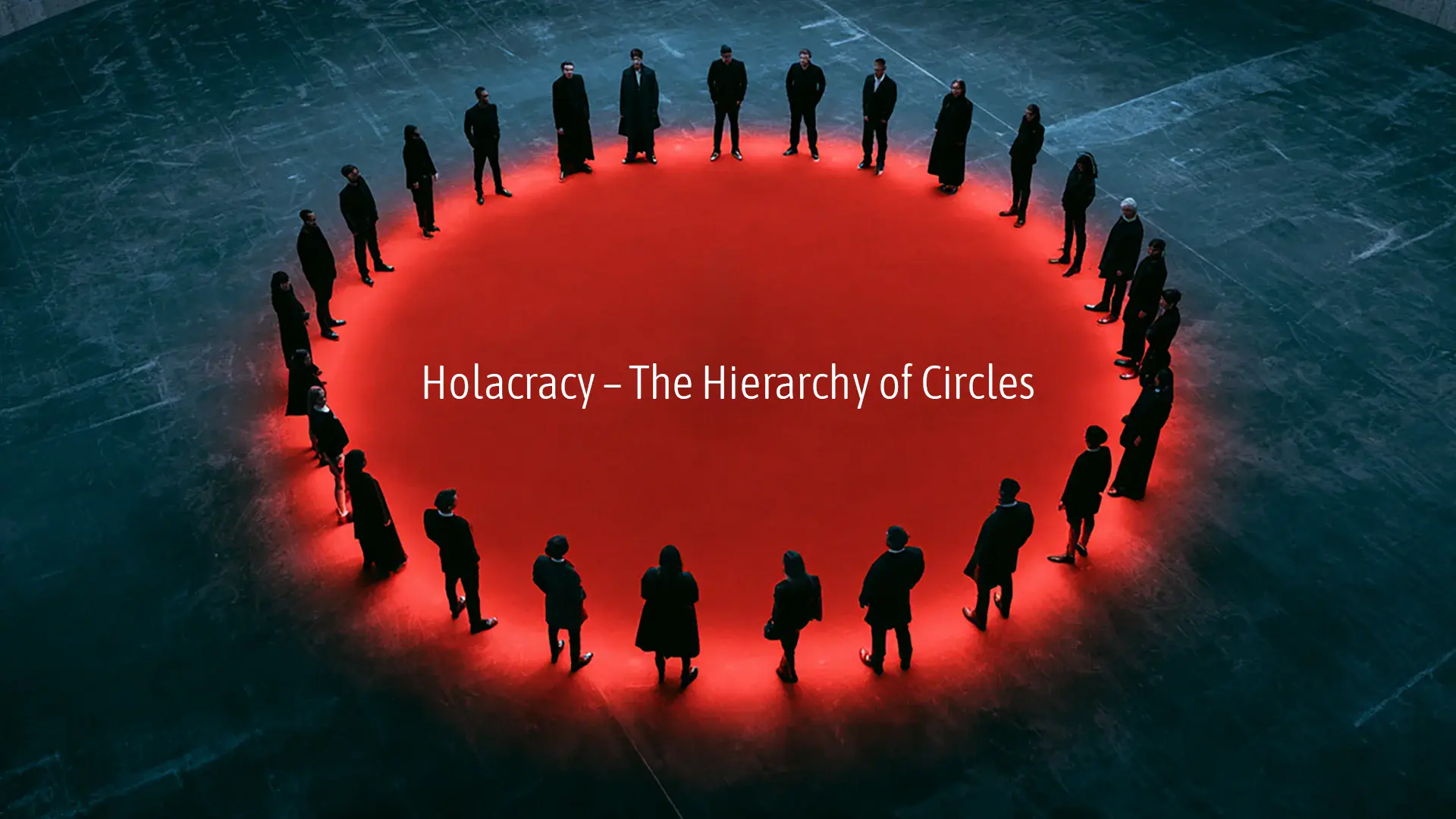

Holacracy – The Hierarchy of Circles
Holacracy replaces traditional management hierarchies with self-organizing teams. A forward-looking corporate management? The example of Zappos raises doubts.
Verified Sources
Tony Hsieh, CEO of online retailer Zappos.com, is a believer in grassroots-democratic organizational structures. In his search for new ways to run a company, he found what he was looking for in Holacracy: an organizational theory that distributes authority and decision-making across self-organizing teams instead of a traditional management hierarchy.
Holacracy was devised by Brian Robertson, a software developer and the founder of Ternary Software. His company had been experimenting with alternative, more democratic organizational structures since its founding. Holacracy was first presented publicly in 2007. Robertson’s Holacracy Constitution followed in 2010 and was meant to serve as the foundation for building new corporate cultures.
Roles instead of positions
Holacracy is built on the idea of replacing job descriptions with roles. In interviews and talks, Robertson likes to repeat a hypothesis nobody can prove: a job description is already outdated the moment it comes out of the printer, unlike a role. Holacracy distinguishes between roles and the people who fill them. One person can hold several roles at any given time. The roles are regularly redefined by so-called circles through a collective governance process, so they keep pace with the company’s constantly changing needs.
Holacracy structures the company’s roles through a system of self-organizing circles arranged in a hierarchy. Each circle has a clear purpose and is accountable to the larger circle above it. However, every circle has the authority to organize itself internally in whatever way best fulfills its purpose.
The term Holacracy traces back to Arthur Koestler’s 1967 book “The Ghost of the Machine,” which is actually an ode to hierarchy. Koestler argues that our entire world is made up of hierarchies of every kind, from language and music all the way to biology and chemistry. Atoms stand in a hierarchy to molecules, molecules to cells, and cells in turn to the organism. All life forms and society itself, according to Koestler, are nested hierarchies of units.
When Tony Hsieh announced in January 2014 that he would introduce Holacracy at Zappos, there was a lot of murmuring. Holacracy had never been rolled out at a company this size (around 1,500 employees). Hsieh’s plans were ambitious: no bosses, no titles, everyone equal, the CEO included. The company was supposed to manage itself. Hsieh wanted to turn Zappos into the model for the organization of the future.
On March 30, 2015, the day finally came. Tony Hsieh officially announced the company’s switch to the new structure. His internal memo opened with the words, “This is a long email, so set aside 30 minutes to read the whole thing.” What followed struck many as deeply unsettling, even though it had been clear for a long time that there would be no escaping Holacracy.
Hsieh wrote that Holacracy was simply the right tool for now to make the shift to self-organization. But he planned to experiment with plenty of other tools down the road. And then he announced that by the end of April, not only the old management system but every management position would be eliminated, because managers would be superfluous in the new structure. Employees who had held management positions would be moved into regular roles, where they would contribute to the good of the company.
All former managers willing to come to terms with the new structure would keep their previous salary until the end of the year, though new tasks would have to be found for them. Anyone unwilling to warm up to the new structure, on the other hand, would have to leave the company. They were made an offer that was generous by US standards, but they had to decide within the next 30 days. In total, 210 employees, about 14 percent of the workforce, took the offer and left. The managers were gone. But were they really?
Somewhere in the endless expanses of Hsieh’s memo, at a point where even the most well-meaning reader’s eyes start to close, there is an interesting detail that exposes the limits of such a change in organizational structure. In 2009, Amazon acquired all of Zappos’s shares. That made Zappos a wholly owned Amazon subsidiary, even though Tony Hsieh remained CEO and the company stayed independent to the outside world. As a publicly traded company, Amazon and its subsidiaries are bound by compliance rules such as Sarbanes-Oxley (SOX). Among other things, these rules require a clearly defined and codified reporting structure. But a reporting structure needs someone to report to. Managers, in other words.
To meet these requirements, Hsieh writes almost in passing, every employee would continue to have a “reporting relationship” in the backend of the HR system. That would only be a compliance requirement, though, and the reporting structure would stay largely invisible to most employees so as not to unsettle them. It remains to be seen how the courts will view this kind of trickery. One thing is already clear: the Holacracy model is unusable, at least for publicly listed companies. Hierarchies can’t simply be abolished there.
Is Holacracy really not hierarchical?
The Holacracy system puts great weight on consensus and democratic decision-making, on everyone’s opinion. At the same time, it is explicitly and heavily hierarchical. Read the introductory articles on Holacracy and the Holacracy Constitution 4.0, and it’s hard to shake the impression that Holacracy is hierarchy on steroids. Hierarchies are spelled out in far more detail than in any conventional organizational structure.
Put simply, Holacracy is the hierarchy of circles. The circles are run according to democratic procedures laid out in great detail, but at the same time, every circle operates inside the hierarchy. Each higher circle tells the circle below it what its job is and what is expected of it. The higher circle can make changes to its “subordinate” circle at any time, swap out people, or even abolish the circle altogether if it doesn’t meet the higher circle’s expectations.
In the Holacracy system, every circle has to fulfill the purpose set by the circle above it. What that purpose is, the Holacracy Constitution doesn’t say. Brian Robertson merely hopes the purpose is “always noble,” but the Holacracy Constitution is completely neutral on the choice of purpose.
So at its core, Holacracy is a set of inward-facing, hierarchical mechanisms that connect the circles. Every circle is required to run the system democratically and openly, with endlessly detailed procedures and processes for things like how meetings are held and how decisions are reached. But no matter how democratic a circle is, it still operates within a vertical hierarchy and has to look upward for instructions on its purpose.
Abolishing traditional hierarchies did more than abruptly change the corporate culture at Zappos. The unexpected departure of 210 employees on the same date tore holes in the organization. Amazon, Zappos’s parent company, now says it hadn’t expected that many departures and that it has to ask whether the severance offer was too generous. Not only did the severance costs far exceed what had been budgeted, Zappos was also unprepared to replace a large number of employees on short notice. The planning had been based on annual turnover of one percent. For the year of the Holacracy rollout, the company had projected an increase to two or three percent. That it would end up at around 14 percent was something nobody in the picture-perfect world of Zappos wanted to imagine.
The future doesn’t look very rosy for the former managers who decided to stay, either. By January 1 at the latest, they will be on regular employee salaries, and performance bonuses and the like will disappear with nothing to replace them. That means a 40 to 60 percent drop in income. In the US, where individual success is still largely defined by how much you earn, losses like that are going to sour the mood.
With Holacracy, Tony Hsieh and his entourage have put one of their sometimes eccentric ideas for a new world order into practice, at the expense of their employees’ futures. What headhunter is interested in a résumé without titles, not to mention that the title is still a mandatory field on online business platforms like LinkedIn? Will it end up like Fred Mossler’s business card, which now says “NoTitle” instead of “Senior Vice President Merchandising,” or like Hsieh’s assistant Liz, who calls herself “Sr. Time Ninja” in her profiles?
What happens when tensions arise between employees? All responsibilities and rules are stored in a piece of software called GlassFrog. But how is software supposed to solve problems between people? And who is ultimately responsible when something goes seriously wrong? Hsieh says it would take three to five years for Holacracy’s values to be fully integrated into the company. Until then, the company would keep relying on “trial and error.” Hsieh wants Zappos to function more like a city and less like a bureaucratic company. Companies, Hsieh says, tend to die at some point. Cities don’t.
Holacracy is still going to confront Tony Hsieh with some major challenges. How he plans to solve them through self-management and self-organization (after all, the CEO role now only exists in the HR backend for SOX compliance) will be interesting to watch.
Only one person is truly happy: Brian Robertson. As co-founder of the consulting firm Holacracy One LLC, he earns money at every step of a Holacracy rollout through consulting and licensing.