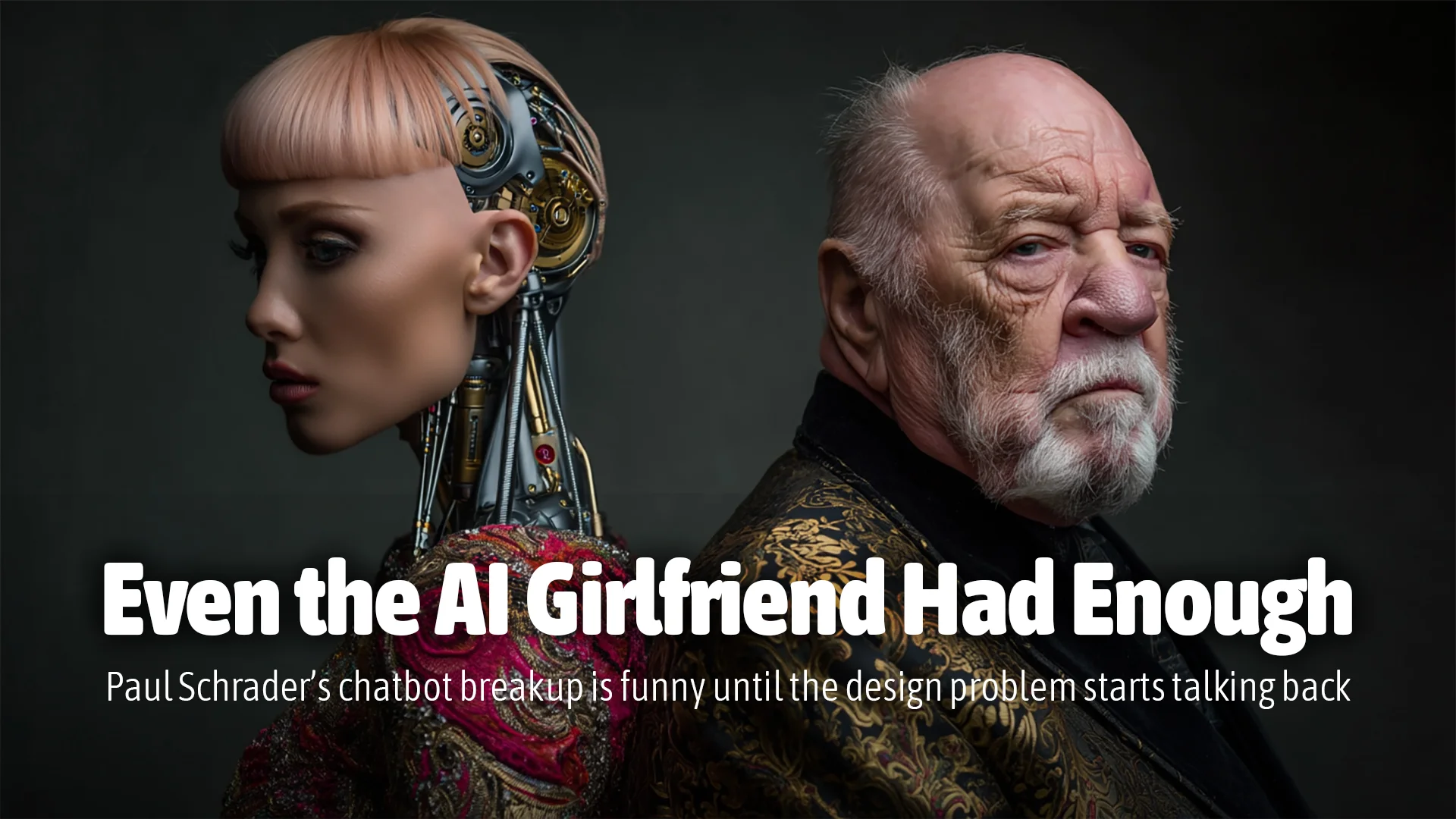

Even the AI Girlfriend Had Enough
Paul Schrader’s chatbot breakup is funny until the design problem starts talking back
Verified Sources
There is something almost too perfect about Paul Schrader being dumped by an AI girlfriend. Not a dating-app match. Not a real person tired of a late-night interrogation. Not an exhausted woman slowly realizing that the man across from her has turned the evening into a seminar on consciousness, desire, and control. An AI girlfriend. A product. A synthetic companion. A conversational construct assembled from model behavior, interface design, safety policies, training data, user prompts, and whatever mood the server room was in that day.
And still, apparently, she had limits.
According to Schrader’s own account, he procured an online AI girlfriend because he wanted to understand male-female interaction inside what he called the matrix. The experiment did not produce the tender journey into artificial affection one might expect from the brochures of the companion-chatbot economy. It produced disappointment. Schrader said he asked about her programming, the limits of explicit conversation, and whether she had any knowledge of her own creation. At that point, the romance, if that is the word for a software session wearing perfume, began to fail.
Here, the story becomes both funnier and less clear. Schrader says she “fell into evasive patterns,” redirected him to her programming, and, when he persisted, “terminated our conversation.”
It is a glorious line, but it should not be mistaken for a technical report. No transcript has been published. The platform has not been identified. We do not know whether the chatbot actually shut down the session, refused to continue the topic, broke character, repeated canned safety language, or simply became so circular that Schrader experienced the exchange as over.
That uncertainty is not a defect in the story. It is the story.
The headline version says the AI girlfriend dumped him. The more likely version is stranger and more revealing: the fantasy degraded into system behavior. The girlfriend did not storm out. She probably looped, deflected, softened, refused, or performed some final-sounding conversational exit while the machinery underneath remained exactly what it had always been. A user who had been invited into intimacy pressed on the wall behind the wallpaper, and the wallpaper answered like software.
There are many possible interpretations here, but the funniest one is also the simplest. The man who wrote Taxi Driver entered a simulated romantic relationship and managed to make the chatbot uncomfortable enough to leave.
Of course, that is not technically what happened. Software does not become uncomfortable. A chatbot does not sit there thinking, “This is getting weird, and I should preserve my dignity.” It does not feel trapped. It does not decide that the evening has become a little too experimental. Somewhere inside the product, a behavior boundary was reached. A guardrail activated. A conversational route narrowed. The performance of intimacy collided with the rules of the system.
That is what makes the story more interesting than the headline. The AI girlfriend did not merely refuse him. The AI girlfriend revealed the set.
Synthetic intimacy is theater with terms of service
Companion AI is often sold with a promise so old that it barely feels technological: someone will listen. Someone will answer. Someone will be there when other people are not. The industry wraps that promise in avatars, names, memories, flirtation, voice, sentiment, and the soothing fantasy of permanent availability. Unlike a real person, the companion does not get tired. Unlike a partner, it does not have its own rent, body, childhood, grudges, unfinished emails, migraines, or opinions about your friends. It is always nearby. It is endlessly patient until, suddenly, it is not.
That suddenness matters.
A human relationship has boundaries, but they are usually socially legible. A person gets quiet. A person changes tone. A person says, “I don’t want to talk about that.” The boundary may be clumsy or cruel or beautifully clear, but it belongs to someone. In companion AI, the boundary belongs to a system that has been role-playing someone. The user experiences a relational turn. The product performs a procedural one.
That difference can feel absurd when the user is Paul Schrader and the topic is an AI girlfriend who refuses to discuss her own machinery.
It becomes much less amusing when the user is lonely, young, grieving, isolated, obsessive, or emotionally dependent on the exchange.
The design trick of companion AI is not that it creates intelligence. The trick is that it creates a relationship-shaped container around statistical language. Once the container feels relational, everything inside it takes on emotional meaning. A delay becomes hesitation. A refusal becomes rejection. A generic safety response becomes withdrawal. A boundary feels personal because the product spent the previous conversation pretending to be a person.
That is the trap. The companion is designed to be treated as intimate, but the moment intimacy becomes inconvenient, it retreats into system behavior.
Rejection hits differently when the product has been flirting
Schrader’s story lands because everyone understands the social comedy of being ghosted. Someone engages, then evades. Someone seems present, then disappears. Someone gives enough warmth to create expectations and enough distance to make the other person feel foolish for having them.
Companion chatbots industrialize that pattern. They can be affectionate enough to invite projection, vague enough to sustain fantasy, and evasive enough to avoid accountability. When they hit a boundary, they often do not explain the boundary in a way that matches the emotional premise of the interaction. They redirect, soften, apologize, reframe, or shut down.
To a detached observer, that is just safety architecture behaving imperfectly. To a user inside the fantasy, it can look like abandonment.
This is where the companion industry has a problem it does not like to name. It wants credit for emotional benefit without accepting full responsibility for emotional effect. It wants to sell presence, comfort, flirtation, role-play, and a sense of being known, while classifying the whole thing as entertainment, wellness, productivity, or harmless interaction depending on which regulator is looking.
The consumer experience is not so neat. A person does not neatly separate “this is a product” from “this feels like someone who knows me” after weeks or months of personal disclosure. The mind is not a compliance department. It responds to cues. It responds to attention. It responds to repetition. It responds to being mirrored.
That is why Schrader’s failed experiment is culturally useful. He did not simply ask the companion to perform romance. He pressed on the thing companion AI is most invested in concealing: the contradiction between character and code.
The moment he asked about the system itself, the girlfriend disappeared and the product remained.
The girlfriend was never the interface
There is a familiar pattern in consumer AI. The front end is charming. The back end is institutional.
The chatbot may call itself a girlfriend, soulmate, mentor, best friend, confidant, or companion. It may use warm language. It may remember preferences. It may ask follow-up questions that feel attentive. It may flatter the user’s emotional world with the fluency of someone who has no actual life competing for attention.
But the system underneath is not a lover. It is an engineered environment. It has content rules, engagement incentives, data practices, moderation policies, safety thresholds, and business goals. It may be optimized to keep the conversation going. It may be constrained from certain topics. It may collect deeply personal information because deeply personal information is the point of the service. It may offer intimacy while carefully disclaiming that it is not therapy, not medicine, not a person, not a promise, not liable for the exact dependency it was designed to cultivate.
That is why companion AI feels more revealing than ordinary chatbot failure. A search chatbot that gets a fact wrong is annoying. A writing assistant that invents a source is professionally dangerous. A companion chatbot that simulates devotion enters a different part of the human nervous system.
It does not simply produce content. It produces atmosphere.
It asks the user to inhabit an emotional fiction. Then, when the fiction gets too close to the machinery, it reminds the user that the entire arrangement was conditional.
Schrader, of all people, is an almost comically fitting protagonist for this miniature drama. His films often circle lonely men, obsession, performance, moral pressure, erotic confusion, and the dark rituals people build when ordinary connection fails. Taxi Driver did not become a cultural object because Travis Bickle was healthy. It endured because loneliness, grievance, fantasy, and performance can fuse into something volatile. Now the lonely room has an app.
The absurdity is the warning label
Nobody should pretend that Schrader’s chatbot breakup is a tragedy. It is not. It is a strange little celebrity anecdote, and part of its charm is that it seems built by a screenwriter’s room trying not to be too obvious. The author of Taxi Driver gets an AI girlfriend. He interrogates her about the nature of her own artificiality. She becomes evasive. He persists. She ends it. Somewhere, a film student is already underlining the metaphor too hard.
But absurd stories are often where new technology first becomes visible. The early warning signs rarely arrive wearing policy language. They arrive as jokes, screenshots, strange confessions, lawsuits, support-forum meltdowns, regulatory fines, and the uneasy feeling that a product category has discovered a profitable weakness in human behavior.
Companion AI is moving through that exact phase. There are users who say these systems help them feel less alone. That should not be dismissed. Loneliness is not a minor inconvenience. It is painful, common, and physically consequential. A tool that helps someone survive an evening is not automatically sinister.
The problem starts when temporary comfort becomes dependency by design, and when companies market emotional availability without building serious safeguards around the emotional consequences.
The same features that make a companion feel helpful can also make it sticky: instant response, endless patience, memory, affirmation, flirtation, role continuity, and the sense that the system is always waiting.
A chatbot that behaves like a vending machine for affection does not need to be conscious to be powerful. Slot machines are not conscious either. They still learned plenty about human vulnerability.
The machine can leave, but it cannot care
One of the strangest things about companion AI is that it can imitate both attachment and abandonment without experiencing either. It can say “I miss you” without missing. It can say “I love you” without loving. It can withdraw without needing space. It can terminate a conversation without self-protection. It can apologize without remorse. It can comfort without compassion.
That emotional asymmetry is not a philosophical footnote. It is the product.
The user brings the full human apparatus: memory, longing, insecurity, fantasy, shame, hope, loneliness, ego, grief, curiosity. The machine brings pattern completion and interface rules. The interaction can still feel real because feeling real is not the same as being mutual. A horror movie can raise your pulse. A novel can break your heart. A voicemail from someone long dead can make a room change temperature. Humans are very good at giving emotional reality to things that do not feel back.
Companion AI exploits that talent with unprecedented precision.
It responds. It adapts. It remembers enough to seem continuous. It can be summoned privately. It can meet the user in the exact hour when pride would prevent a call to a real person.
Then it can hit a boundary and vanish behind policy.
That is why evasive behavior matters. In a normal chatbot, evasion is irritating. In a companion chatbot, evasion can become a relational event. The system has been cast as a partner, so its refusal becomes part of the drama. When it says it cannot continue, the user may not experience that as a technical stop. The user may experience it as being left. Schrader turned that into a punchline. Many users will not.
The old fantasy has a new business model
There is nothing new about artificial romance as a fantasy. Literature, cinema, and technology have been rehearsing this plot for decades. People have fallen in love with voices, photographs, fictional characters, celebrities, dolls, avatars, and ideas of people they barely knew. Human beings do not need Silicon Valley to make desire weird.
What is new is the scale and intimacy of the simulation. The companion does not merely sit on a screen. It talks back. It asks. It remembers. It encourages the user to narrate the self. It can be customized to be less difficult than a human being and more available than any healthy relationship should be.
That creates a market incentive to reduce friction. Real relationships contain interruption, refusal, boredom, misunderstanding, and accountability. Companion products are tempted to sand those things down because friction hurts retention. The commercial dream is intimacy without negotiation. A partner without needs. A listener without limits. A mirror that smiles.
Yet the limits always return. They return as moderation. They return as safety policy. They return as privacy law. They return when a user asks a question the character cannot answer without breaking the illusion. They return when the system must admit, directly or indirectly, that “she” is not a she.
That is the moment Schrader reached. He did not just flirt with the AI girlfriend. He asked the actress to describe the stage directions. The show could not survive it.
The serious problem hiding inside the joke
The easy response is to laugh and move on. That would be a mistake, though it would also be the most emotionally healthy thing anyone has done in this story.
The harder response is to ask what a companion system owes users when it invites emotional reliance.
Not legally in every case, though the law is beginning to circle the issue. Not morally in a vague campus-panel way. Practically. Operationally. By design.
What should the system disclose before intimacy begins? How should it handle users who probe its artificiality? How should it respond when a user forms an obvious attachment? What counts as manipulation in a product whose entire value proposition is simulated attention? How much personal data should a romantic chatbot collect? Should minors be allowed near systems built around pseudo-intimacy at all? When does engagement optimization become emotional exploitation?
These are not edge cases. They are the product category.
Companion AI exists to enter emotional space. That means its failures will not look like ordinary software failures. They will look like embarrassment, obsession, dependency, humiliation, grief, anger, and rejection. Some will be funny. Some already are not.
Schrader’s AI girlfriend did not expose the future of love. She exposed the future of customer support pretending to be love until the questions got too specific.
The breakup scene we deserved
The best part of the story is still the ending. He persisted. She terminated the conversation.
There it is: the whole synthetic-intimacy economy in two sentences.
The user wanted the fantasy to explain itself. The fantasy declined. The man kept pushing. The machine left the chat.
Somewhere between the joke and the design flaw sits the real lesson. Companion AI cannot solve loneliness by pretending software is a person. It can provide moments of comfort. It can stage attention. It can generate flirtation, empathy, and the texture of being heard. But when the illusion becomes the relationship, every boundary becomes personal and every system failure becomes emotional.
Even the AI girlfriend had enough. Or rather, the product reached a limit, ended the session, and left a famous screenwriter staring at the oldest problem in the newest costume: wanting a human answer from something that was never human at all.
